OP.

Case study

Environmental Reporting Platform

Environmental reporting required multiple stakeholder roles to coordinate submissions, reviews, supporting documents, and feedback across long review cycles. I designed a structured multi-role workflow that brought these interactions into one platform, making responsibilities, status, and next steps easier to understand throughout the review process.

Client and selected project details have been anonymized.

The Challenge

Turn a fragmented reporting and review process into a digital workflow that could support multiple stakeholder roles, long review cycles, documents, feedback, and changing responsibilities without oversimplifying the process.

Duration

~3 months

Product status

Launched · Ongoing maintenance

My role

As part of a two-designer UX/UI team, I contributed to workflow analysis, user flows, role-specific wireframes, and final interface design, working closely with the PM, developers, and client stakeholders throughout the project.

Users

  • Submitters
  • Coordinators
  • Reviewers
  • Decision authorities

Constraints

  • Multiple roles & permissions
  • Non-linear review cycles
  • Existing design system
  • Accessibility requirements
  • ~3-month delivery

Key decisions

  • Role-specific views
  • Persistent status model
  • Contextual feedback & collaboration

Outcome

Brought a fragmented review process into one shared workflow with clearer ownership, status visibility, and feedback across roles.

What I would improve

More structured usability testing with representatives of each role before handoff, followed by product analytics after launch.

Multi-section nomination form with section navigation, a progress bar, multilingual name fields, and species tables
Supporting Documents table with search, filters, and each document's format, author, linked submission, and status

The Context

Designing for multiple roles without losing a single source of truth

The reporting process spanned submissions, supporting documents, comments, and repeated review rounds. Different stakeholders entered at different stages, while information often lived across emails, shared files, and spreadsheets.

The design work focused on mapping review stages and role handoffs, then translating them into a shared status model, role-specific interfaces, and contextual collaboration patterns within the client’s existing design system.

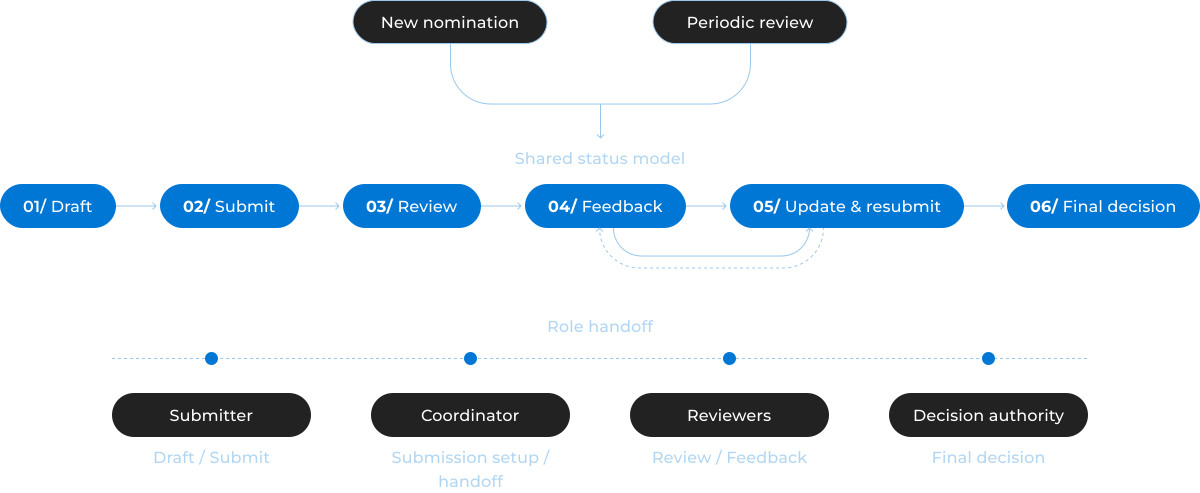
Mapping the Workflow

From two reporting paths to one shared status model

The platform had to support two connected processes — new reserve nominations and periodic reviews — each moving through several stakeholder roles, review stages, feedback loops, and handoffs before reaching a final decision.

Mapping the review stages and role handoffs revealed a shared progression behind both processes. This became the basis for a consistent status model that could stay clear across different roles and review scenarios.

Design Constraints

Complex review requirements had to become a clear, usable experience

01/

Multiple roles and permissions

Submitters, coordinators, reviewers, and decision authorities interacted with the same submissions, but needed different actions, information, and levels of access.

02/

Non-linear review cycles

Submissions could move forward, return for clarification, or reopen for editing, so status and ownership had to remain clear across repeated handoffs.

03/

Existing design system and accessibility

New workflows and interfaces had to fit the client’s established design system and accessibility requirements rather than introduce a separate visual language.

04/

Compressed delivery window

The core workflows and interfaces were designed and refined within approximately three months through regular stakeholder reviews.

Key Product Decisions

Turning a complex review process into clear role-based experiences

01/

Different roles, different views of the same submission

Evidence

Process documentation and stakeholder input showed that submitters, coordinators, reviewers, and decision authorities interacted with the same submission, but needed different actions, information, and permissions at different stages.

Insight

Showing the same interface and controls to every role would add unnecessary complexity and make ownership harder to understand.

Design decision

We used role-specific views built around the same submission and status model, surfacing only the information and controls relevant to each role.

Role-specific dashboard views for the Submitter, Reviewer, and Coordinator roles

02/

Making status and next steps visible

Evidence

Process documentation and stakeholder reviews showed that submissions did not always move forward linearly: they could return for clarification, reopen for editing, or move between several review stages before reaching a final decision.

Insight

A status label alone was not enough. Users needed to understand where a submission was now, what had already happened, and what action was expected next.

Design decision

We introduced a persistent progress model that kept the current review stage, completed and upcoming steps, and the next available action visible throughout the submission experience.

Submission dashboard showing a persistent progress stepper, with annotations for current stage, completed and upcoming steps, and next action

03/

Centralizing review conversations

Evidence

Feedback and follow-ups were spread across different parts of the review process, making ongoing discussions harder to track across submissions.

Insight

Teams needed one place to see active conversations, follow-ups, and unresolved feedback without searching across separate channels.

Design decision

We introduced a dedicated collaboration space that brought ongoing discussions together across submissions and made review communication easier to follow.

Tablet showing a Collaboration panel with threaded comments and replies attached to a submission

Iteration Spotlight

Bringing feedback closer to the content

Nomination form with a Collaboration panel showing a threaded comment attached to a specific form section
Centralized discussionsLost contextContextual feedback

Initial concept

The dedicated collaboration space made ongoing discussions visible in one place.

Concern

During reviews, stakeholders found that comments could still lose context when they were separated from the exact form section they referred to.

Iteration

We added section-level comments directly inside the form, allowing users to clarify specific fields without leaving the content they were reviewing.

Final decision

The final experience combined both layers: a shared collaboration space for broader discussions and contextual comments for section-specific feedback.

Launch & Reflection

From core review workflows to a broader reporting platform

Outcome

The platform launched and continues to be actively used and developed. In a recent internal project update, the team reported around 730 invited users, 41 forms actively in progress, one completed review submission, two more nearing completion, and five new reserves created through the platform.

These figures provide an early indication that the platform is supporting real reporting and review workflows across multiple organizations and roles.

Reflection

This project reinforced that designing complex workflows is less about simplifying the process itself and more about making responsibilities, status, and handoffs understandable without removing necessary complexity. Seeing the platform continue to support active submissions across multiple roles made that lesson even more tangible.

If I continued the work, I would introduce more structured usability testing across roles and use product analytics after launch to identify where users still encounter friction.

Reserves overview dashboard showing country statistics, a map of biosphere reserves, and tables of reserves and statutory documents
Mountain lake landscape